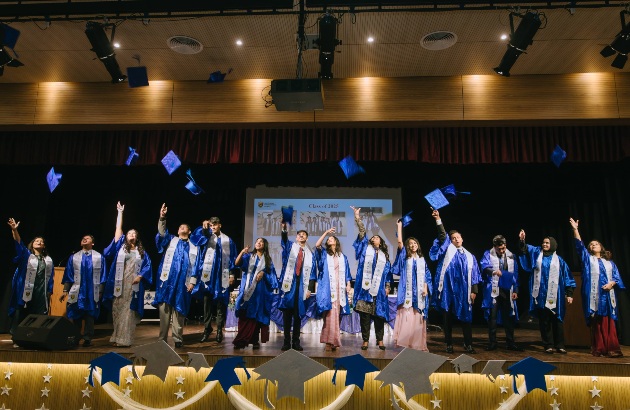
The International Baccalaureate (IB) Diploma Programme at Australian International School Dhaka (AUSIS) is a rigorous, internationally recognised two-year pre-university programme for students in Grades 11 and 12 (ages 16–19).

At AUSIS, the DP develops confident, reflective and academically capable learners prepared for success at leading universities worldwide. The programme balances academic challenge with personal growth, encouraging students to think critically, communicate confidently, conduct independent research and contribute meaningfully to their communities.

Our DP students graduate not only with strong academic results, but with advanced research skills, critical and creative thinking abilities, leadership qualities and a global outlook that prepares them for higher education and beyond.

About the Diploma Programme

The IB Diploma Programme is recognised globally as one of the most challenging and respected pre-university qualifications. Students study six subjects across disciplines while completing three core components that develop research, reflection and service.

At AUSIS, we focus on:

  • Academic excellence
  • International mindedness
  • Ethical leadership
  • Research and inquiry skills
  • University readiness

The programme encourages students to explore global issues, develop independent thinking and become confident communicators.

Why Choose the DP at AUSIS?

At AUSIS, the DP experience is personalised, structured and highly supportive. Teachers provide consistent feedback, close academic monitoring and individual guidance throughout the two-year programme, ensuring students remain confident and academically secure.

Students benefit from:

  • Individual academic mentoring
  • Dedicated Extended Essay supervision
  • Structured CAS guidance and reflection support
  • University and career counselling
  • Engaging classroom discussions and collaborative learning
  • A safe, inclusive and academically focused school community

The DP Curriculum at AUSIS

Six Subject Groups

Students study six subjects — one from each subject group — ensuring both breadth and depth of learning.

  • Group 1: Studies in Language & Literature
    • English A: Language and Literature
    • Bengali A: Literature
  • Group 2: Language Acquisition
    • English B
    • French ab initio
    • French B
    • Spanish ab initio
  • Group 3: Individuals & Societies
    • Business Management
    • Economics
    • Digital Society
    • Environmental Systems & Societies
  • Group 4: Sciences
    • Biology
    • Chemistry
    • Physics
    • Environmental Systems & Societies
  • Group 5: Mathematics
    • Mathematics: Analysis & Approaches
    • Mathematics: Applications & Interpretations
  • Group 6: The Arts
    • Visual Arts

Students typically select three Higher Level (HL) and three Standard Level (SL) subjects based on their academic strengths and university aspirations.

Students who prefer not to take a Group 6 subject may choose an additional subject from Group 3 (Individuals & Societies) or Group 4 (Sciences), in accordance with IB regulations.

Students may also choose to study two subjects from Group 1 (Studies in Language & Literature). In this case, they are not required to take a Group 2 subject and may be eligible for the IB Bilingual Diploma, subject to IB criteria.

**Subject availability may vary based on student enrolment and timetabling considerations.

Higher Level (HL) and Standard Level (SL)

Higher Level (HL) subjects involve greater depth of study, approximately 240 teaching hours and more complex analytical expectations.

Standard Level (SL) subjects provide a strong academic foundation, with approximately 150 teaching hours, while maintaining the rigour and standards of the IB Diploma Programme.

The DP Core

Theory of Knowledge (TOK)

Theory of Knowledge (TOK) is an interdisciplinary course that encourages students to reflect on how knowledge is constructed across different subject areas. Students explore questions about truth, evidence, perspective and bias, developing critical thinking, ethical reasoning and the ability to evaluate knowledge claims effectively.

Extended Essay (EE)

The Extended Essay (EE) is a 4,000-word independent research paper, also described as formal academic writing. Guided by a supervisor, students investigate a topic of personal interest, developing advanced research, referencing and analytical skills that prepare them for university-level study.

Creativity, Activity, Service (CAS)

Creativity, Activity, Service (CAS) runs throughout the two-year Diploma Programme requires students to participate in creative projects, physical activities and community service experiences. Through structured reflection, students build self-awareness, resilience and a strong sense of responsibility.

The DP Core ensures that learning extends beyond textbooks and examinations, engaging students in real-life situations, hands-on experiences, reflective thinking and meaningful community involvement.

Assessment and Academic Standards

Assessment in the DP includes:

  • Internal Assessments (coursework, investigations, oral examinations, portfolios and presentations)
  • External IB paper-based examinations at the end of DP Year 2
  • Research-based tasks and analytical essays

The programme is externally moderated to maintain international standards.

DP results are recognised by universities worldwide, including institutions in Australia, UK, USA, Canada, Europe and Asia.


Student Life in the DP

DP students at AUSIS participate in:

  • Academic competitions and subject enrichment activities
  • Student leadership initiatives
  • Community service projects
  • Cultural and creative events
  • University preparation workshops

Students build meaningful relationships, develop leadership skills and gain confidence through active participation in school initiatives and community engagement.


University Pathways

AUSIS DP graduates pursue competitive academic pathways in leading universities worldwide, including:

  • Engineering and Technology
  • Business, Economics and Finance
  • Medicine and Health Sciences
  • Law and International Relations
  • Biological and Environmental Sciences
  • Computer and Information Sciences
  • Architecture and Design
  • Agriculture and Sustainability Studies
  • Social Sciences
  • Creative and Performing Arts

The IB Diploma is internationally recognised and valued by leading universities worldwide.

AUSIS DP graduates are prepared not only to gain admission to competitive universities, but to succeed academically once there.

Frequently Asked Questions (FAQ)


What is the difference between Higher Level (HL) and Standard Level (SL)?

HL subjects involve approximately 240 teaching hours and greater depth of study. SL subjects involve approximately 150 teaching hours while maintaining IB academic rigour.


How is the DP assessed?

Students complete a combination of internal assessments and external examinations. Final grades are awarded by the International Baccalaureate.


How many subjects do students take?

Students study six subjects in addition to completing the DP Core (TOK, Extended Essay and CAS).


What is the maximum IB score?

The IB Diploma is graded out of 45 points, with up to 7 points awarded per subject and 3 additional core points from TOK and the Extended Essay. Creativity, Activity, Service (CAS) must be successfully completed in order to be awarded the Diploma.


How many points are required to obtain the IB Diploma?

Students must achieve a minimum of 24 points, meet subject-specific requirements and successfully complete the DP Core components (TOK, EE and CAS) in order to be awarded the IB Diploma.


What is the IB Bilingual Diploma?

The IB Bilingual Diploma is awarded to students who successfully complete two Group 1 languages or meet specific IB criteria demonstrating proficiency in more than one language.


Is the IB Diploma recognised internationally?

Yes. The IB Diploma is recognised by universities around the world and is valued for its academic rigour and research focus.


How does AUSIS support DP students?

Students receive academic mentoring, Extended Essay supervision, CAS guidance and university counselling to support both academic progress and future planning.


Can students choose subjects based on career goals?

Yes. Subject selection is guided by academic staff and university counsellors to ensure alignment with future university pathways.


Do DP students have time for anything beyond academics?

Absolutely. Most successful Diploma Programme students lead very full lives. They are often members of athletic teams and involved in a wide range of activities. Time management and organization are key skills the IB develops in students.


Do DP teachers receive special training?

All DP teachers receive professional development in the IB’s approaches to teaching and approaches to learning from certified IB workshop leaders. This is a requirement for IB World Schools implementing the DP.


How can I learn more about the IB and DP?

  • Visit the IB website at ibo.org
  • Attend school meetings and events
  • Speak with your school’s DP coordinator and DP teachers

Hear from our Parent

“We chose the DP at AUSIS because of its academic rigour and global recognition. What impressed us most was the personalised guidance our child received — regular feedback, close mentoring and genuine care from teachers. We saw remarkable growth in confidence and independence.”

“The structured support system at AUSIS helped our child navigate the challenges of the Diploma Programme with confidence. The school’s focus on critical thinking, responsibility and university readiness gave us reassurance that our child was well prepared for the future.”

Student Testimonials

“The DP at AUSIS challenged me to think independently and manage my time effectively. Through the Extended Essay and TOK, I developed strong research and analytical skills that prepared me for university-level work. The consistent support from teachers made the journey demanding but manageable.”

“CAS allowed me to step outside my comfort zone and take initiative in projects that truly mattered. Balancing academics with service and leadership helped me grow not just as a student, but as a person.”

Ready to Begin Your Child’s Learning Journey?

Take the next step toward a world-class education at AUSIS. Our team is here to answer your questions about admissions, the Primary Years Programme, and all aspects of school life.

    Get in touch